Bhutan's renewable grid: a national strategy built around sustainable power
Hydropower has been the backbone of Bhutan's economy for decades, and it shows up as a stated national enabler rather than an incidental fact. Bhutan's National AI Strategy, published in 2025, names energy-efficient high-performance computing, GPU clusters, robust networks and sustainable power together, as enablers of the same national ambition. That framing matters for anyone evaluating a renewable energy data center in the country: the power question and the compute question were written into the same strategy document, not bolted together after the fact by a developer.
Recent financing activity is consistent with that direction. The World Bank and the Royal Government of Bhutan signed financing agreements for the Dorjilung hydroelectric power project in May 2026, and a World Bank assessment from April 2026 described Bhutan's growth outlook as remaining strong. Neither of those releases is a capacity guarantee for any specific site — interconnection studies, grid capacity and seasonal hydrology still have to be verified project by project — but they are real, citable evidence that Bhutan's hydropower base keeps expanding rather than standing still.
Why hydropower changes the economics of AI compute
Most renewable-power pitches to data center developers lead with the tariff: cheap clean electricity, quoted per kilowatt-hour. That framing undersells what actually determines whether a GPU campus works. A rack drawing up to 100 kW doesn't care about a favourable headline rate if the grid connection behind it can't deliver that power reliably, on the schedule a phased build actually needs. For AI training and inference workloads, sustained high-density draw is normal operating behaviour, not a peak case — so grid connection reliability, not just price, is the variable that determines whether a hydropower data center actually performs.
That's the distinction that separates a country with a hydropower base from a country running tariff arbitrage across jurisdictions with thin or contested grid capacity. Bhutan's hydropower generation is a long-established part of national infrastructure, which is a stronger starting point for a reliability conversation than a market where renewable capacity is new or intermittent. It's still a starting point, not a substitute for diligence — grid studies, interconnection timelines and seasonal hydrology all have to be confirmed for any given site, and buffering demand against a variable supply is exactly the problem the next layer of the design is built to solve.
Inside Rinchen's design: liquid cooling, BESS, and a sub-1.3 PUE target
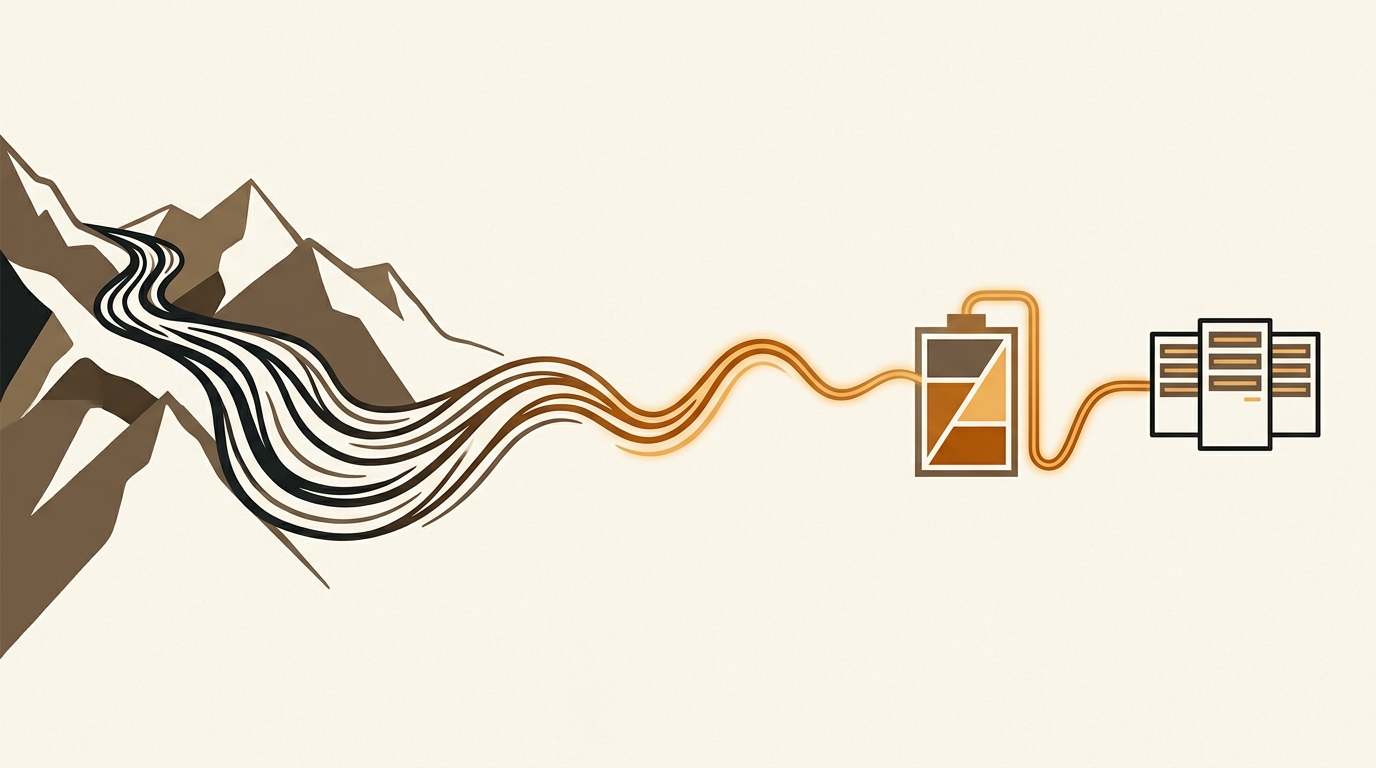
Rinchen's platform is built as a repeatable chain: renewable grid and switchgear feed a battery energy storage system (BESS) for grid flexibility, which supplies liquid-cooled GPU racks, which run through a coolant distribution unit (CDU) and loop heat transfer system out to dry coolers for final heat rejection. A double-loop design keeps the rack-side (IT) cooling circuit physically separate from the facility-side heat-rejection circuit, which is what allows a liquid-cooled GPU campus to target sub-1.3 PUE and rack densities up to 100 kW as design targets — not completed-project performance, and not a substitute for commissioning data once a phase is actually built.
The BESS sits at the exact point where hydropower's reliability advantage still needs an assist: it absorbs demand spikes and short supply variance so the campus isn't purely at the mercy of second-by-second grid conditions, which matters more in a hydropower-led grid with seasonal flow variation than in a thermal-generation grid with flatter output. Every block in that chain is designed to be repeatable rather than bespoke, so adding capacity later means replicating a proven module rather than re-engineering the system — part of how Rinchen targets a 20-30% CAPEX advantage against conventional builds, again as a target rather than a track record.
Phased by design: from a 10 MW pilot toward 100 MW
Rinchen's capacity plan starts at a 10 MW pilot and scales in phases toward 100 MW, with a 3-6 month module deployment target after approvals for each increment. That phasing isn't only a capital-discipline decision — it's an energy decision. Committing to one large block of contracted load against a grid before interconnection performance and seasonal generation have been verified in practice would be exactly the kind of optimism the rest of this platform is built to avoid.
A phased build lets each increment of sovereign AI infrastructure be sized against power that has actually been confirmed, not projected, before the next phase is committed. It also means the modular, liquid-cooled design described above gets tested at 10 MW before it's relied on at 100 MW, which is a more conservative posture for a hydropower-dependent site than committing the full campus upfront and hoping the grid keeps pace.
Five stop/go gates: how verified power and demand — not optimism — drive delivery
Rinchen's delivery path runs through five stop/go decision gates: site and power, demand, design, capital and scale. Each gate is tied to verified power, fiber, safeguards and contracted demand — not to a signed press release or a strategy document, however encouraging those are as context. The site and power gate specifically is where a hydropower data center's power story has to convert from a national-level fact into a site-specific one: confirmed grid connection, interconnection timeline and capacity headroom for that location, checked before capital moves.
That discipline runs in both directions. Bhutan's hydropower base and stated national strategy make the site-and-power gate easier to clear in principle than in a country with no comparable renewable base or policy alignment — but they don't clear it automatically. Each phase still has to earn its way through the same gate on its own evidence, which is the same standard any credible AI infrastructure build should be held to, regardless of how favourable the surrounding energy story looks.
What Bhutan gains: digital exports, a sovereign AI reserve, and local jobs
The energy case for AI data centers in Bhutan isn't only about what a developer or compute buyer gets out of reliable hydropower. It's also about what the country gets from turning that power into something more valuable than an export commodity: digital export revenue from selling computation while the infrastructure itself stays in Bhutan, and a sovereign AI reserve — Bhutan-controlled capacity set aside for public services, research and Dzongkha-language AI rather than fully committed to outside customers.
A phased, power-verified hydropower data center also builds quality technical jobs in engineering, operations, cybersecurity and AI, backed by local training rather than imported for the length of a single build. And because each phase is only committed against confirmed power and contracted demand, the campus becomes what a hydropower-led grid actually benefits from most: a bankable, long-duration power customer that helps make the long-term demand case for further hydropower investment, rather than a short-term draw that leaves the grid's economics unchanged once construction ends.
