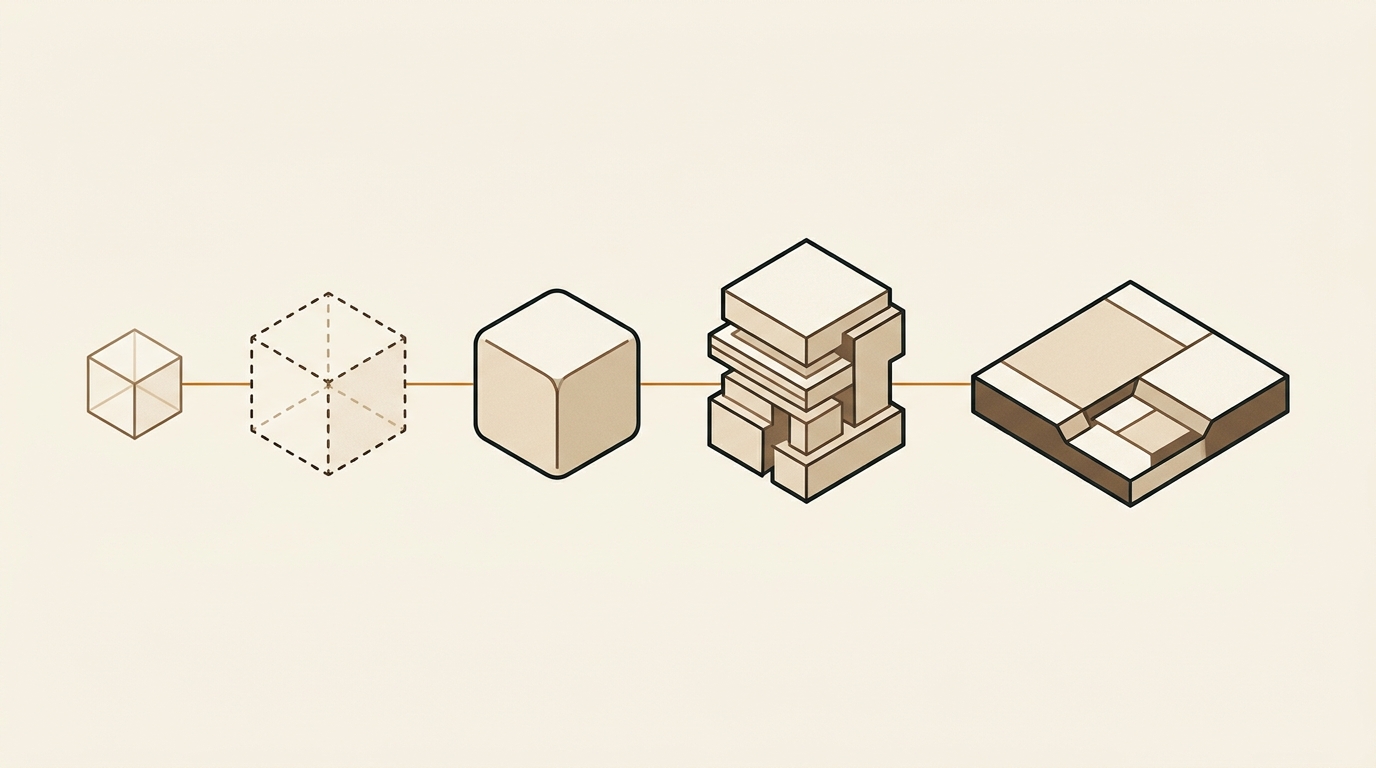
Buy vs. rent AI compute is really five decisions, not two
Most conversations about AI compute purchasing models collapse into a single question: buy or rent? That framing hides the fact that renting alone covers at least two structurally different products, and buying covers three more. GPU-as-a-Service, reserved AI clusters, IaaS and bare metal, wholesale capacity, and colocation each carry a different commitment length, a different degree of control over the physical stack, and a different exposure to whoever operates the facility underneath them. Comparing GPU-as-a-Service vs reserved AI clusters as if they were the only two options skips past the wholesale and colocation buyers who aren't purchasing compute cycles at all — they're purchasing power-backed infrastructure or a home for hardware they already own.
Rinchen offers all five products from the same physical campus, which is a useful vantage point for describing them honestly rather than as a sales funnel that always ends at reserving a cluster. The right AI compute purchasing model for a given team is a function of workload variability, security and data-residency requirements, the model roadmap's time horizon, and how much of the stack — orchestration, networking, hardware lifecycle — a buyer wants to own directly. Getting that fit wrong is expensive in both directions: over-committing to reserved capacity ties up capital against a roadmap that might change, and under-committing to hourly access can leave a training run competing for GPUs during exactly the week it can least afford to.
GPU-as-a-Service: when flexible, hourly access is the right fit
GPU-as-a-Service is hourly or monthly access to GPU capacity without a long-term reservation attached to it. It fits workloads that are inherently uneven: a research team running short-lived training experiments, an inference workload that spikes with product launches or seasonal demand, or a team validating a new model architecture before committing to the infrastructure it will eventually need at scale. The appeal is straightforward — no multi-year capacity commitment, no need to forecast utilization months in advance, and the ability to scale down as quickly as scaling up.
The tradeoff is that flexible access is priced for flexibility, and shared infrastructure means less control over exactly which rack, network segment or cooling loop a workload lands on. For teams whose GPU demand genuinely fluctuates — as opposed to teams who assume it will and later find their workload has become steady-state — that tradeoff is the right one. The comparison that matters here is less GPU-as-a-Service vs reserved AI clusters in the abstract, and more: does this workload's demand curve look like a spike or a plateau over the next 6-12 months? A spiky curve belongs on GPU-as-a-Service; a plateau is usually cheaper and more predictable as a reservation.
Reserved AI clusters: committing capacity to a model roadmap
Reserved AI cluster capacity is dedicated hardware built around a specific model roadmap, security profile and deployment window, rather than shared with other tenants on an hourly basis. It suits teams that already know their training cadence, need consistent network topology for large-scale distributed training, or have compliance and data-isolation requirements that shared infrastructure can't satisfy. Because the capacity is planned in advance against a named deployment window, a reserved cluster can also be built around specific rack density, cooling and network requirements rather than whatever configuration happens to be available in a shared pool.
The commitment that makes reserved clusters efficient — capacity held for one customer's roadmap — is also what makes the decision worth diligence before signing. A reserved AI cluster is only a good trade if the roadmap behind it is real: a training schedule, a product launch, or a security requirement that shared infrastructure genuinely can't meet, not a hedge against future growth that may or may not arrive. Buyers weighing bare metal GPU vs cloud GPU tradeoffs inside a reserved arrangement should also ask what happens to unused capacity between training runs, since that gap is where reserved clusters either pay for themselves or sit idle.
IaaS, bare metal, wholesale capacity and colocation: for buyers who want their own stack
Three more products sit outside the GPU-as-a-Service-vs-reserved-cluster comparison entirely, because they're not selling compute cycles — they're selling infrastructure. IaaS and bare metal give a customer virtual machines, storage and networking, or physical servers reserved exclusively for them, for teams that want to run their own orchestration and software stack without sharing a hypervisor or scheduler with anyone else. That matters for teams with existing MLOps tooling built around specific hardware access, or workloads where the overhead of a managed compute layer isn't worth what it buys.
Wholesale GPU capacity is a different customer again: cloud operators, neoclouds and regional infrastructure platforms that need power-backed supply at scale to build their own compute products on top of, rather than a single team's training job. Colocation and hosting is the fifth path — a home for hardware a customer already owns, built to provide the liquid cooling and resilient power design that a standard colocation facility, designed around air-cooled racks from an earlier era, usually cannot support at 100 kW densities. All three depend more on the physical characteristics of the facility than on the software layer, which is why the physical design choices below matter more for these buyers than for anyone shopping hourly GPU access.
Why the physical layer sets the ceiling on all five products
Every one of these five compute products is downstream of the same physical constraints: how the facility cools its racks, how efficiently it turns grid power into usable compute, and how quickly new capacity can actually be brought online. Rinchen's design targets are PUE below 1.3 and rack densities up to 100 kW, pursued through liquid cooling with a double-loop design that separates the rack-side IT circuit from the facility-side heat-rejection circuit — renewable grid power and switchgear feed a BESS for grid flexibility, then liquid-cooled GPU racks, a CDU for loop heat transfer, and dry coolers for final heat rejection. These are design targets, not completed-project performance, and any buyer evaluating a liquid-cooled AI data center in Bhutan or anywhere else should ask for measured, not modelled, numbers once a site is operating.
The other physical constraint is time. Conventional data-center builds run 24-36 months from first meeting to commissioned campus; Rinchen's module deployment target is 3-6 months after approvals — a target for the module build itself, not the full path through feasibility, framework agreements and site works that precedes it. That distinction matters for anyone comparing timelines across providers: a fast module deployment target is not the same claim as a fast time-to-first-workload, and the two should never be quoted interchangeably. Whatever the marketing language, the physical layer — cooling, power and deployment speed — is what determines whether any of the five products above can actually be delivered on the schedule promised.
A buyer's diligence checklist: apply the five stop/go gates
Rinchen's own delivery path runs through five stop/go decision gates before capacity is committed: site and power, demand, design, capital and scale. Each gate is tied to verified evidence — interconnection studies, fiber routes, safeguards, contracted demand — rather than optimism about future orders. That same structure is a reasonable checklist for evaluating any AI compute provider's claims, regardless of which of the five products a buyer is considering: has power been verified through an actual grid study, or is it described as planned? Is the demand behind a reserved cluster contracted, or projected? Are cooling and density figures measured from an operating site, or quoted as design targets?
None of the market context in this space is settled enough to take at face value — supplied estimates of 250+ GW of new data-center capacity planned globally by 2030, with roughly 100 GW considered a serviceable segment, are company estimates that require independent diligence, not established fact. The same caution applies to any single provider's cooling, density or deployment-speed claims, including Rinchen's own. A buyer who runs a provider's numbers through site-and-power, demand, design, capital and scale gates before committing — whether the product on the table is hourly GPU-as-a-Service or a wholesale, power-backed reservation — will end up with a materially better picture than one who compares marketing pages alone.
